Teesside Archaeological Society | New Facebook page and group

Hello all,
Saxon JewelIn addition to the Mesolithic and lithics research I’m doing, I’m also involved in the Teesside Archaeological Society where I’m Chair and eCommunications officer. We’ve made excellent progress in building the 2014 lecture and events programme—plenty of big names, fascinating topics, finds-handling and an extra bonus lecture in early summer. Catching up with the twenty-first century, we’ve now launched an official page on Facebook where you can stay up to date with news, events, fieldwork, lectures and download our quarterly eMagazine—TEESSCAPES. We’re up to 75 followers after just two days. Thanks for the “Like”! Our TAS NEWSFLASH emails will continue for eNews subscribers.TAS-Fb-Header

Alongside this page, there’s an informal Facebook Group where members and friends can share their adventures, discussions, pictures, news and ask questions.

Spence

Compelling Kickstarter digital project | 3D Virtual Prehistoric Worlds | Donate as little as £1

Kickstarter_VPW

Donation window is now closed but was very successful!

Digital heritage professional Marcus Abbott is using Kickstarter, an innovative way to fund projects, to raise donations for his Virtual Prehistoric Worlds project—an explorable visualisation of a 3D digital world generated from archaeological and palaeo-environmental data.

“This project is a visual representation of what we know about a past landscape, it combines archaeological data and scientific data with cutting edge digital recording and visualisation techniques to produce a virtual world.

This world is a representation of the Bronze Age in East Anglia and focuses on an area known to be of religious significance during this time. The landscape is a wetland environment and has been generated entirely digitally. The archaeology has been reconstructed from actual evidence found on sites in the area. Round houses and wooden platforms, track ways, fences and the great causeway structures of Flag Fen are all present in the landscape.”

You can pledge as little as £1 to support this exciting project and join more than 58 backers who have already offered over £1,000. There are just seven days to go—and every extra pound helps bring the project to realisation. The funding window closes on 7 October 2013.

Spence

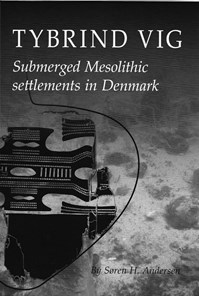
New Book | Tybrind Vig Submerged Mesolithic settlements in Denmark | Ertebølle

Just published and eagerly anticipated: Tybrind Vig | Submerged Mesolithic settlements in Denmark

TybrindVig_DKPart of the series Jysk Arkæologisk Selskabs Skrifter (77) and the subject area Archaeology | By Søren H. Andersen

With contributions by Bodil Bratlund, Kjeld Christensen, Hans Dal, Kasper Johansen, Lise Bender Jørgensen, Claus Malmros, Ole Nielsen, Kaj Strand Petersen, Kirsten Prangsgaard, Kaare Lund Rasmussen and Tine Trolle

ISBN 978 87 88415 78 0 | Hardback: kr. 499.95+VAT+Shipping | 527 pages, ill. | Published 2013

Available from Aarhus University Press | Credit cards accepted in DKR
NB | £ GBP doesn’t seem to work with Visa or Mastercard: use the Kr option

Breakdown (UK)

Subtotal kr. 499.95
Shipping kr. 280.00
Total without VAT kr. 679.96
VAT (25%) kr. 99.99
Total kr. 779.95 (1 DKr = £0.11)

Open Exclusion | The Personal Open Access Experience

Updated | 6-Jun-2013 to add LSE blog link
Updated | 7-Jun-2013 to add “blogs as scholarly publication” link

The issue of open access is a boiling pot of frustration (cost) and anxiety (ethics and legality).

open-accessFor independent researchers, like myself, whether previously in academia and/or aspiring to be enrolled, or for community practitioners (I loath the term “amateur archaeologist“) or for members of the public where even access to public libraries is becoming an increasing luxury (if that library has access at all to academic journals, print or online)—open access is a friction point.

While governments, UK and Federal US included, are grappling with and legislating for open access to learned materials, funded by or as a part of publicly financed research, the incumbent publishing monopolies are lobbying to parry such initiatives based on “sustainable cost” doctrines, and their financial interests therein.

Personal Experience

I can certainly vouch for the pain, being outside academia right now, that pay-wall “open access” causes. I subscribe to the few e-publishers and academic societies that I can afford—a gradually diminishing number since I don’t presently have a regular income stream. I am grateful, as a university alumnus, in having access to JSTOR, although in archaeology the titles which are freely accessible are far from comprehensive, especially for fields like Mesolithic archaeology—a discipline that also spans many specialisations in science and social science, the humanities, cultural heritage management (CRM) and derivative disciplines. I am even more grateful for the “green” and (very rare) “gold” open access vehicles that allow me either time-delayed or immediate access to scholarly material.

Implications

One thing is certain: I will likely be several steps behind those lucky enough to be within formal education or post-doc (yet paying excruciating tuition fees for the pleasure). Open exclusion is part of the reason. That feels neither fair nor productive—the public are an equal and obligatory participant, a partner in our shared heritage, moreso in the evolution and management of our shared environment, the collective owners of our cultural assets? The public are not a simple “consumer bucket” happy to receive amorphous outputs or media sound-bites. Exclusivity and access-by-means are surely forms of cynical discrimination unworthy of our societies, not least those that espouse a lifetime education and education-for-all ethos? Aren’t these educational aspirations also being subjugated to a market-driven “economic return” mandate, naive in its focus on immediacy and therefore myopic in leveraging the true meaning of past, place, presence, well-being and footfall for healthier (and less welfare-costly, more inclusive, more sustainable, more attractive) communities?

Example

And yet, if I were to subscribe to the venerable Journal of Archaeological Science (publisher: Elsevier), by example, it would be beyond my budget (online access is a 5-user license). They are a respected and profuse publisher. If I were to pay-to-download every article they publish across monthly volumes in a given year, I would have to pay over $11,000 (obviously far more than the individual subscription, but it does illustrate my point around reasonable cost—many papers are only six or so pages). Something is amiss?

Returns

Any law of diminishing returns suggests a tipping-point between over-pricing in any given marketplace and realising income streams as a function of volume-based consumer viability—if not “popular” demand. I really don’t mind paying a few dollars/euros/pounds for a worthy, scholarly and life-changing article. I do, however, resent paying $31.50 per article or a mandate to cluster papers into discounted blocks that are still priced beyond my means.

Please read THESE blogs

These excellently written blogs go a long way to explaining both the terminology as well as the seemingly intractable issues that are not without tragedy. I highly recommend reading them. There are plenty more too.

» Sustainability at Any Price is not Sustainable: Open Access and Archaeology
By: Eric Kansa, UC Berkeley and OpenContext.org

» Academics and universities must continue to develop open access alternatives to break the monopoly of large publishers
By: Ann McKechin MP (LSE blog)

» Blogs as scholarly publication: “Taking a Chance: My Blog is a Publication”
By: Katy Meyers (2011) Bones Don’t Lie (blog), Michigan State University | The comments are also supportive and interesting

And now think about how YOU are and will be affected, how you will respond, what you will say, how you will canvass for a fairer outcome, what you will do.

Acknowledgements

Prof Julian D Richards (University of York) for posting it on Twitter today. York is also home of the Archaeological Data Service (ADS) who work continuously to digitise archaeological resources for the greater good. The authors of the ASOR blog need to be congratulated for a well-written and well-appraised status quo and portent for some difficult battles ahead.

Microburin

Här har aldrig varit tomt | This place has never been empty | Mesolithic Sweden

Exceptional Mesolithic landscape—or indeed “wetscape”—at Motala Ström in East Middle Sweden.

MotalaStrom_videoFurther to the last post about Kanaljorden and the impaled Mesolithic skulls, this wonderful short film was released on 25 May 2012 (18 mins with English subtitles) and takes a landscape perspective to showcase some of the incredible organic finds, as well as lithics too. It’s beautifully produced and features—in addition to breath-taking archaeology—some of the inimitable heroes of Scandinavian and Mesolithic archeology: Lars Larsson, T. Douglas Price and Fredrik Hallgren, project manager.

Decisions decisions

You can make up your own mind about the “phallus”, plus watch some of the beautifully decorated artefacts—dagger, club and more. As the documentary makes clear, Sweden is blessed with contract archaeology that allows extensive and wide-area investigations. It’s compelling stuff indeed, with over 400,000 finds since 1999, and continuing.

Make contact

Hey, if you like these blogs about state-of-the-art Mesolithic archaeology, why not Like and Share? On Twitter the hashtag #mesolithic works, and why not visit Facebook Mesolithic Miscellany (not my site)? My personal Twitter name is @microburin

Impaled Mesolithic Skulls in a Lake | Kanaljorden, Motala, Sweden still chills

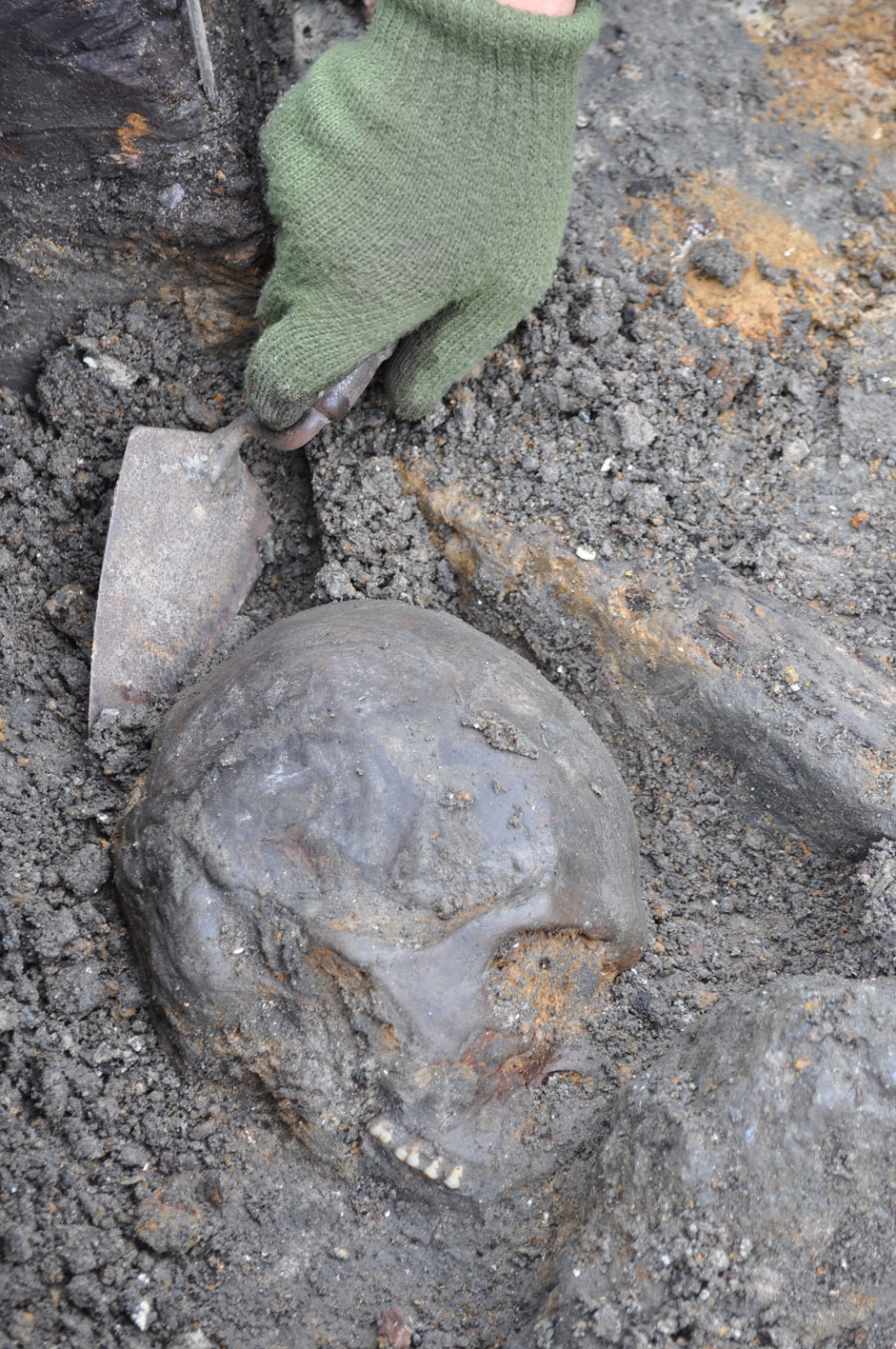
Kanaljorden_Motala_Sweden_SiteIt may not be British Mesolithic, and it may be oldish news—originally press-released in 2011—but these discoveries still chill the soul. Visually macabre they may also be, but they offer ultra-rare glimpses of hunter-gatherer behaviours and social complexity. The site, discovered ahead of a railway construction, would have been interesting anyway, even without the extraordinary finds.

Overview

Kanaljorden_Motala_Sweden_Skulls

Adapted from original press release and online sources. Analysis continues and final reports are still some way off. Photos Fredrik Hallgren / Stiftelsen Kulturmiljövård.

Archaeological excavations at the site Kanaljorden in the town of Motala, Östergötland in Central Sweden (2009–11) unearthed a complex Mesolithic site with ceremonial depositions of human crania in a small lake. The skulls have been handled through a complex ceremony that involved the displaying of skulls on stakes and the deposition of skulls in water. The rituals were conducted on an enormous (14×14 m) stone-packing constructed on the bottom of a shallow lake.

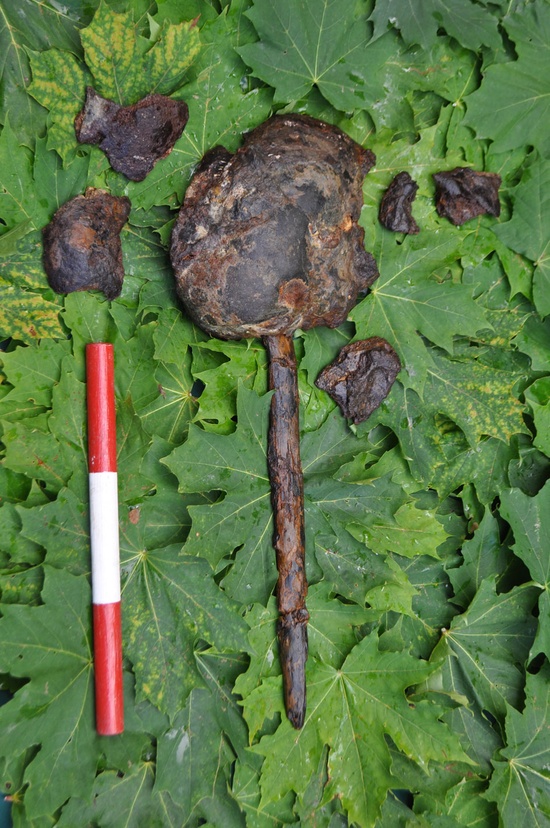
Kanaljorden_Motala_Sweden_SkullBased on the more intact skulls eleven individuals have been identified, both men and women, ranging in age between infants and middle age. Two of the skulls had wooden stakes inserted into the cranium. In both cases the stakes were inserted the full length from the base to the top of the skull. In another case a temporal bone of one individual, a woman, was found placed inside the skull of another woman. Besides human skulls, the find material also included a smaller number of post-cranial human bones, bones from animals as well as artefacts of stone, wood, bone and antler. The skulls have been dated to 6212–5717 Cal BC and two dates on worked wood 5972–5675 Cal BC), making them seven to eight thousand years old. The excavations were conducted by Stiftelsen Kulturmiljövård, led by Fredrik Hallgren, in advance of the construction of a new railway.

“It will be interesting to hear of the results of the laboratory analysis of stable isotopes and—if very lucky—aDNA: are the remains of “dearly departed” or “trophies of defeated enemies.” Another interesting question is what were the state of the skulls when they were put on the stakes? Were they recently chopped-off heads or were they already de-fleshed? No other finds from that period offer any comparative material so it truly is a great mystery we are dealing with here!” – Tænketanken (blog)

Regional Background

Kanaljorden_Motala_Sweden_Leister“The town of Motala was brought to the attention of Mesolithic researchers ten years ago with the excavation of the large Mesolithic settlement Strandvägen, located by the shore of the river Motala Ström. The Strandvägen dig uncovered lithics, a large faunal assemblage as well as numerous tools of bone and antler, categories of finds seldom found in Central Sweden. The excavations at Strandvägen and another riverside site, Verkstadsvägen, continued through 2009–2011 in parallel with the dig at Kanaljorden. While both Strandvägen and Verkstadsvägen are located directly by the shore on opposite sides of the river, Kanaljorden is situated 80m from the river and instead on the edge of a small lake, now a peat fen.” more »

Read more