Sea-faring news | Adventure archaeology | The best fish & chips in the world
 Dear microburins,
I’m teasing slightly, but glad to see archaeology in local news in North Yorkshire—and a new scoop-it mesolithic news item from the Whitby Gazette.
The North-East Yorkshire Mesolithic Project is completing its current funded phase in 2013 by looking at a ‘coastal’ site near Whitby where flints recovered from volunteer and professionally led field walking suggest activity from the Mesolithic through the Neolithic and Bronze Age. Nearby locations complete the story through to the Roman period (farms, villas and signal stations), 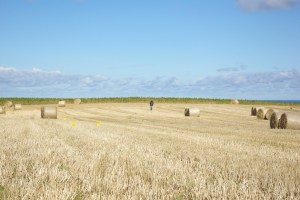 Anglo-Saxons (royalty) right up to the present. It’s also a stunning location today, right above cliffs (near Runswick Bay) with views southwards towards Whitby, north over some of the highest sea cliffs in England, eastwards toward Denmark and The Netherlands over the dark North Sea (there since only around 6500 BC).
I’m chuffed I made it into the volunteer field-walking pic (I’m the one in the middle) and may be able to eat Whitby fish & chips off myself? More seriously, the Mesolithic in NE England is compelling—a nexus of chronological, social and territorial themes—and back to the end of the last glaciation (Late Devensian) over 13,000 years ago.
Read more | Summer 2012 adventures →
♦ Spence
 Extending from human and animal footprints preserved in mud at Goldcliff East (Newport, south Wales), Prof Martin Bell (University of Reading) heads a project to recover Mesolithic artefactual and environmental evidence ahead of the construction of the Severn barrage. The barrage will artificially raise water levels and so the archaeology is at risk of silting and erosion.

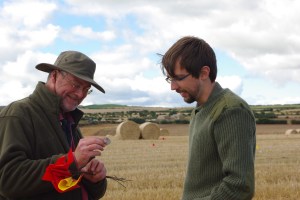 enjoying lithic finds during 2012 fieldwork at Goldsborough near Whitby on the north-east coast of Yorkshire.

 microburin