Lithics Studies Society | Journal 33 2012 now out | Why not join?

Lithics33The latest journal, No. 33 for 2012 is just out, and sexy. Why not join the Lithic Studies Society?

Flint and stone tools have been manufactured and used since the earliest times and arguably they represent the world’s oldest technology. The Lithic Studies Society was founded in 1979 to advance the international study of lithic industries, and particularly flaked and ground artefacts, in the broadest possible context. Member’s interests are diverse, spanning Palaeolithic to historic periods across many areas of the world. The Society provides a convivial forum for the exchange of ideas and information.

The Society has over 350 members from four continents. Membership is growing steadily, and they are always delighted to welcome new members. The Society is open to all who have, or would like to develop, an interest in lithic artefacts of any period. Members receive:

The membership year runs from 1st October to 30th September and the journal Lithics is published annually. The AGM takes place in October and all members are welcome. Individual rates are £15.76 (including 76p PayPal levy).

TEESSCAPES Teesside Archaeological Society eNews | Apr 2013

The latest edition is out—packed with news and events!

  • TEESSCAPESEditorial Review
  • April Lecture Reminder | Tue 23 Apr 7.30pm Stockton Library : Dr Jim Innes (Durham) on the palaeoenvironments and landscapes of Fylingdales Moor, North York Moors
  • Activities & Events | Lectures, activities, events, fieldwork, training and more
  • Site Notes | The latest discoveries from the Tees area and NE England, Pipeline developments and consultations
  • Action Stations | Bamburgh Research Project crowd-funding campaign, English Heritage Angel Awards, Pevsner update for County Durham
  • Browser | This month’s recommended Browsing, Listening and Reading items
  • About TAS | How to Join | eNews Archive
  • Also available as a PDF download

Remember | eNews is free – spread the word about TAS!

Love the rich, distinctive heritage of North East England

Spence

A flair for imperfections | Can we see Mesolithic kids?

Keywords | Mesolithic, Stone age, Stone tools, Lithics, Children, Apprentice

Image_Mesokid

A good article on PHYS.ORG by Karen Anne Okstad (15-Apr-2013) on one of my favourite subjects: childhood and apprenticeship in the Mesolithic—if not throughout prehistory.

“To most people, a useless flint axe is just that. To archaeologist Sigrid Alræk Dugstad (University of Stavanger), it is a source of information about Stone Age children.”

Read the article » | http://phys.org/news/2013-04-flair-imperfections.html

Suggested Reading

If you like the subject (and gender issues too), also read:
  • Ferguson, J. 2008. The when, where, and how of novices in craft production. Journal of Archaeological Method and Theory 15(1), 51–67.
  • Finlay, N. 2008. Blank Concerns: Issues of Skill and Consistency in the Replication of Scottish Later Mesolithic Blades. Journal of Archaeological Method and Theory 15(1), 68–90.
  • Ingold, T. 1993. Technology, Language, Intelligence: a consideration of basic concepts. In K. Gibsen and T. Ingold (eds), Tools Language and Cognition in Human Evolution, 449–472. Cambridge: University Press.
  • Johansen, L. and Stapert, D. 2005. Stone Age Kids and their Stones. In M. Sørensen and P. Desrosiers (eds), Technology in Archaeology. Proceedings of the SILA Workshop. Publishing from the National Museum Studies in Archaeology and History Vol. 14. Copenhagen.
  • Kamp, K.A. 2001. Where Have All the Children Gone?: The Archaeology of Childhood. Journal of Archaeological Method and Theory 8(1), 1–34.
  • Moore, J. and Scott, E. (eds). 1997. Invisible people and processes : writing gender and childhood into European archaeology. London; New York: Leicester University Press.
  • Sternke, F. 2005. All are not hunters that knap the stone – a search for a woman’s touch in Mesolithic stone tool production. In N. Milner and P. Woodman (eds), Mesolithic studies at the beginning of the 21st century, 144–163. Oxford: Oxbow.
  • Sternke, F. and Sørensen, M. 2009. The Identification of Children’s flint knapping products in Mesolithic Scandinavia. In S. McCartan, R. Schulting, G. Warren and P. Woodman (eds), Mesolithic Horizons, 722–729. Oxford: Oxbow.
  • Society for the Study of Childhood in the Past

Spence

Image credit: hans s | Foter | CC BY-ND

University College Dublin to reconstruct Mesolithic house | New blog

Keywords | Stone age, Mesolithic, Hut, Mesolithic house, Experimental archaeology, Archaeology, Ireland, University College Dublin

mount_sandel

This UCD School of Archaeology project aims to build a Mesolithic (middle stone age)  house in the Centre for Experimental Archaeology. Basing the experiment closely on archaeological data, they will use stone age technologies and materials in an attempt to learn something of the real conditions within which these remarkable structures were built.

Visit the UCD buildingmesolithic Blog »

Background
Howick

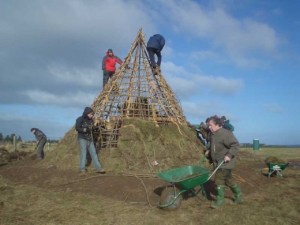
Howick “tepee” reconstruction

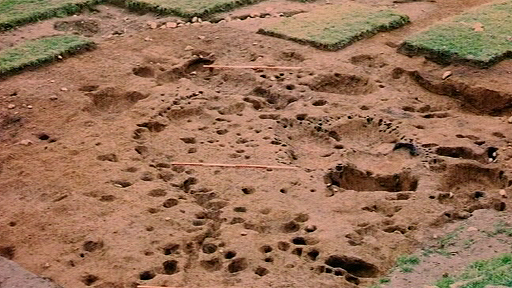
A series of discoveries over recent years have transformed the twentieth century database of Mesolithic structures in the British Isles and Ireland. There’s an emerging picture that the first “architecture” was more complex, more frequent and more enduring than the hitherto scant records of stakehole arcs, ‘windbreaks’ and tent weights¹. So, for example, Howick in Northumberland (NE England), and perhaps new discoveries on the Firth of Forth (Scotland) and Merseyside (NW England), suggest occupation over more than a hundred years, whether intermittently or permanently, in sub-circular structures around 6m in diameter with internal hearths and lithic (and sometimes organic) evidence for many activities.

In Ireland, Mount Sandel (Londonderry) is a well-known excavation by Peter Woodman in the 1970s² and uncovered substantial structural remains. Similarly Howick, excavated by Clive Waddington³, provided evidence for occupation over multiple generations with periodic rebuilding events. Recent discoveries at East Barns in East Lothian³ and Echline (Scotland) suggests the genesis of semi-permanent or permanent structures very early in the Late Mesolithic (8000 BC)*, perhaps coinciding with the increasing inundation of the North Sea up to about 6400 BC, a palpable event between generations that finally separated Britain from mainland Europe and rendered a considerable, productive landmass uninhabitable—Doggerland. Combinations of isostatic land rise/fall and seal level changes have also altered the British west coast topography significantly**. Is there an association between displaced or maritime communities and the advent of the house? Or is it that most evidence (and tentative aggregation sites) are now under the sea?

* My feeling is that the early Mesolithic “structure” at Star Carr needs more scrutiny (2-3m diam. hollow with associated postholes extending it to 4m non-linearly) and more evidence from the environs to substantiate a “dwelling” or purposeful structure. Ref ANTIQUITY 86(334) Conneller et al. pp 1004-1020.

** England is still sinking and Scotland still rising today—no political commentary intended!

Image_Mesolasershow_hanssThis exercise will be interesting to watch since there are a number of ways to interpret the archaeological evidence for post- and stake-holes, scoops, pits and hearths as well as patterning of artefactual evidence. Bigger questions remain around the significance of these structures for a hunter-gatherer ancestry thought, until now, to have been far more mobile and transient than this new evidence suggests?

Visit the UK Sites and Finds page for some of the more recent media coverage → | or view some news headlines on scoop.it »

Selective References

¹ For example, see (a) Wickham-Jones, C.R. 2004. Structural Evidence for the Scottish Mesolithic. In A. Saville (ed.) Mesolithic Scotland and Its Neighbours (229-42). Edinburgh: Soc Ant Scot; (b) Smith. C. 1992. Late Stone Age Hunters of the British Isles. London: Routledge.

² Woodman, P.C. 1985. Excavations at Mount Sandel 1973-77. Northern Ireland Archaeol Monographs No 2. Belfast: HMSO.

³ Howick | Waddington, C. (ed.) 2007. Mesolithic Settlement in the North Sea Basin: A Case Study from Howick, North-East England. Oxford: Oxbow.
East Barns | Gooder, J. 2007. Excavation of a Mesolithic House at East Barns, East Lothian, Scotland: An Interim View. In C. Waddington and K. Pedersen (eds). Mesolithic Studies in the North Sea Basin and Beyond (49-59). Oxford: Oxbow.
Very early Neolithic site | Londonderry N Ireland

derryLondonderry | Very early excavated Neolithic settlement that has been under analysis for a decade. Finds to go on show at the Tower Museum.

“A 6,000-year-old Stone Age village excavated in Londonderry has been heralded as being of global significance. The settlement is seen as of world importance as it is only the second of its type found in Ireland and is unique in the range of activities found to have been carried out there…”

» Belfast Telegraph 21 Feb 2013 | More UK Mesolithic sites & finds


Wessex Archaeology | Photo Library of reconstructions

WessexArch_ImagesReconstructions, visualisations and artists impressions of places, people and objects through the ages.

“A nice range of images by period, although the Mesolithic is short of shelters, huts and the like. A great life outdoors until it snowed?”

Visit the gallery » | Wessex Archaeology home »

Spence