Dear microburins,
 A post-free month, and then two come along all at once! I dare say there’s a third fermenting somewhere in the back of my gaseous, bubbling, overly-knapped, conchoidially-fractured, corticated and (breath) patinated mind.
Microburin is coming up for a breath of Spring air and a transition to other duties—back to the lithics lab and conference planning. Many of you know I’m a voluntary editor for Council for British Archaeology Yorkshire and voluntary chair for the refreshed Teesside Archeological Society (now with on an upward-trending membership again). I’m proud to contribute to both organisations.
CBA Yorkshire
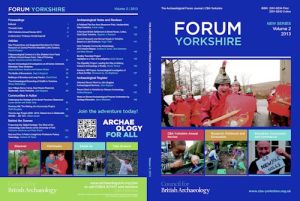
 Much of the winter was spent editing CBA Yorkshire’s FORUM YORKSHIRE archaeological journal. This is a new series that sits between the informality of past magazine-style annual publications and the more traditional county and thematic periodicals that we must complement. I think we have found our sweet spot whilst maintaining a standard that attracts a broad range of well-written articles spanning the variety of archaeology in the county—academic research, commercial developer-led, educational and community.
 Finding a Sweet Spot
In this year’s volume 2 (for 2013), while somewhat volatile in terms of the readiness of committed articles and their respective back-end project progress, I think we have managed to create a portfolio that does justice to the scope of activities happening across our Ridings. The excellent contributions under two banners, in particular, give us a unique mix and presence in the publication record: Communities In Action and Behind The Scenes give voice to multifaceted community ventures, some completed and others in-progress, as well as demonstrating some of the inner mechanics of the archaeological discipline and its many allied specialisations. I am particularly pleased to host papers from the Archaeology Data Service (ADS) courtesy of Catherine Hardman and Potted History—artisan archaeological potter Graham Taylor who continues to supply expertly researched and skillfully rendered replica ceramics to the likes of Stonehenge visitor centre and many museums. His grooved ware renditions are, simply, huge in every respect!
Paper versus online
The debate between the value-by-weight of print versus electronic publication is one side of the story. With a typical 50% of CBAY Membership who are Internet-enabled, paper still holds a special value and a relied-upon communication vehicle, no matter the increasing postage costs. Rural Internet (broadband) access, most especially across a County with profound wi-fi topographic dynamics—the utterly urban to the completely rural (BT and UK Government take note)—are veneered with a generational capability in terms of computing confidence. With a demographic, also nationally typical, that sees a majority membership over the age of 55, we are far from a tipping point wherein “online” would be a reasonable expectation for all. Let me ask: how comfortable do we all feel with the corporate/banking/government coercion toward a ‘paperless’ life, especially when so many transactions rely upon proving identity and residence by virtue of providing original paper records? We’re in a quandary. Moreover, the Heartbleed openSSL security bug debacle hasn’t helped. Who is safe as the first hackers and abusers are arrested?
 Open Access Commitment
Hence, CBA Yorkshire have agreed upon full, free open access to our journal after a grace period of one year—green access level. FORUM YORKSHIRE vol 1 (2012) is therefore available online now, tied to the publication of vol 2. We’re using ISSUU as an e-publishing vehicle and maintain a PDF download using Dropbox. As time allows, our plan is to host all papers via ADS too in PDF-A archive format. It will take a little time to prepare this, with due diligence.
 TEES Perspectives
The second major effort has been TEESSCAPES, the e-Magazine of the Teesside Archaeological Society. Our presence on the Internet—Email, Website, Facebook and Twitter—have been innovations only recently, literally the last year or two. We started with email using the fantastic MailChimp cloud technology. Our website, hosted on WordPress, appeared just before Christmas. Grasping the social media bullet, Facebook came next—we achieved over 158 followers within a two weeks (I need to shout out here: that was jaw-dropping!) and the comment “at last! TAS joins the 21st century“. That’s my favourite. Girding ones loins, knowing how social media requires regular monitoring and messaging, Twitter followed to complement the suite. And now Facebook and Twitter are integrated into our website alongside regular news posts (backed up with email campaigns).
What hour are you in?
The major benefit is to reach an extended audience of tens-of-thousands in an instant. While Facebook’s reach is increasingly limited, by function of the drive for advertising-based commercial “promotion” (i.e. you have to pay), Twitter still allows an awesome capability. So, for example, using vehicles (and hashtags) like #YorkshireHour, @RyedaleHour and several others across Cleveland/Teesside and the north-east of England, a lecture invite can reach an audience of over 25,000 people, in a split second. We have garnered quite a few new members, and many more interested followers, as a proven result. All praise for social media, say I! (But not Facebook).
The Power of Guest Writers
 The latest edition, TEESSCAPES Spring 2014, also includes two great articles on top-of-mind topics by guest writers. David Mennear, an osteo-archaeologost and TAS friend, guides us through the complex but thrilling world of human origins and the latest discoveries in Georgia and South Africa. Meantime, Kim Biddulph of @SchoolsPrehistory gives us a taste for what the forthcoming inclusion of Prehistory in the English National Curriculum means in terms of teaching readiness and the impact on seven-year olds—this is not far short of a curriculum revolution, accounting for the missing million years of hominin and human presence in Britain. Schools Prehistory provide advice and wonderful resources for teachers.
Your Chance to Share
As I eye up the forthcoming seasonal editions of the magazine, I am hoping (and perhaps you can help) for equally insightful and informal contributions that explain the inner and outer workings of archaeology and the significance of recent discoveries. Go on! Write for us? Email teesarchsoc.news@gmail.com.
That’s it for now. It’s been a thrilling week on the back of a winter of gruel. Archaeology MUST REMAIN accessible to ALL. At whatever cost—surely?
◊ Spence
 Six-and-a-half minutes of Mesolithic fire-making at the archaeological open-air museum Oerlinghausen (despite there being a fire already lit behind!). Werner is using a bow-and-drill and then tinder. There is a momentary intrusion of 21st-century curiosity, but otherwise this is pleasantly atmospheric.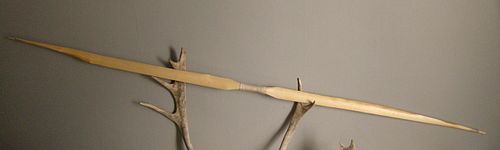
 Also see Mesolithic stories on the microburin
  Recently, Palaeolithic and Mesolithic archaeology has been breaking boundaries worldwide. Papers and posters presented at the
  Wild Things: Recent advances in Palaeolithic and Mesolithic research [Paperback]

 microburin