◊ Dear Microburins,
 Tees Archaeology and Historic England have just published a summary report about the North-East Yorkshire Mesolithic Project that completed recently. The report is aimed at a general readership and accompanies an illustrated e-booklet aimed at kids, as well as a guide to prehistoric lithics (flint).
Although Teesside is perceived as a recent industrial landscape, the natural history and archaeology is all around. We have definite evidence for the early post-glacial pioneer colonisers, reindeer hunters, around 8500 BC—the Early Mesolithic—as well as evidence for the filling out of the landscape in the later Mesolithic into the advent of Neolithic farming communities and monument builders. This is a long six-thousand year epoch and one of rapid climate change, warm-and-cold events, rising sea levels, a tsunami, and the creation of today’s Island Britain.
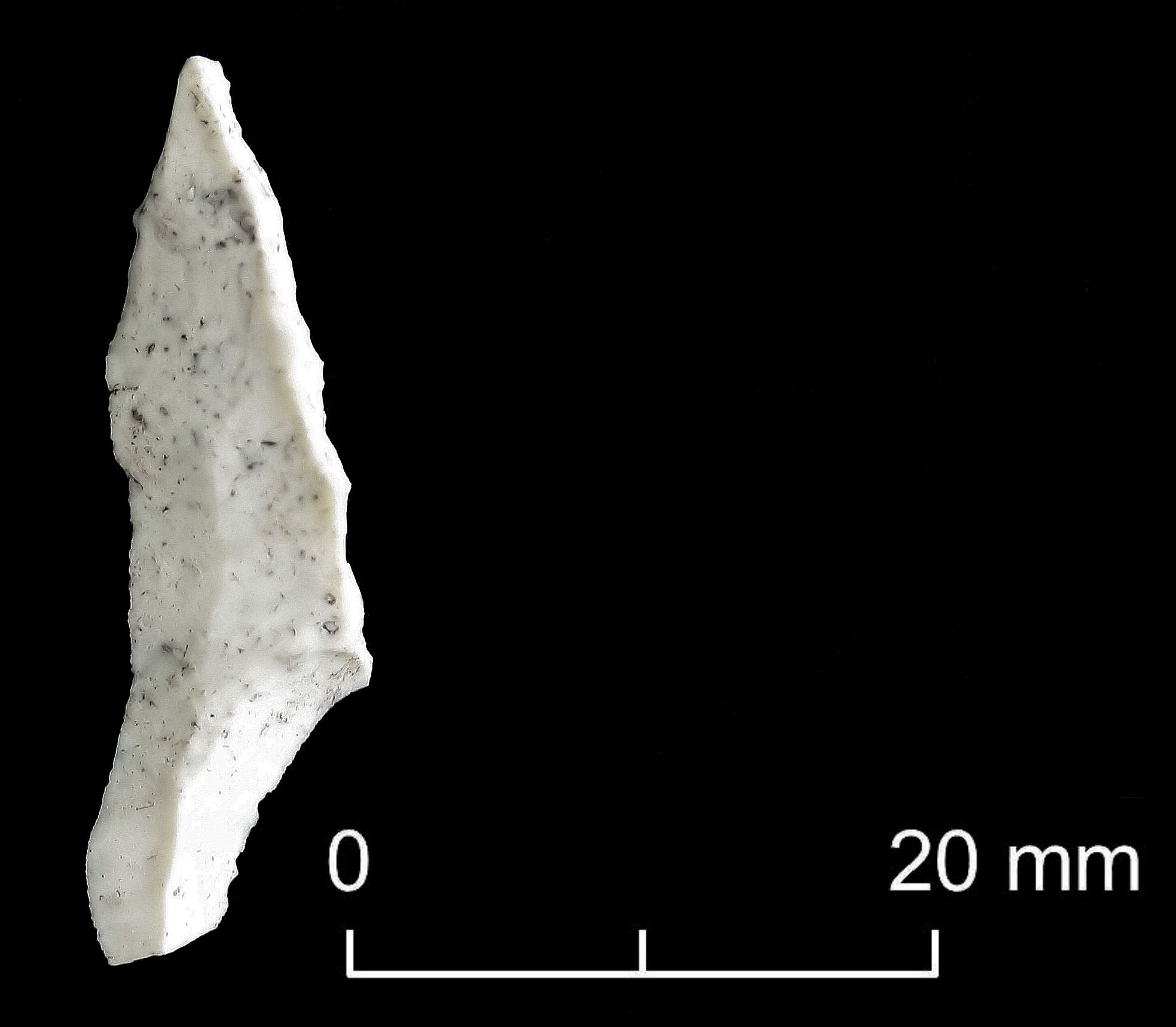 Early Mesolithic flint projectile point, Deepcar type, c. 8500 BC (a little later than Star Carr) from Eston Hills, Teesside. White flint has sources in East Yorkshire and Lincolnshire, many tens of kilometres away. These rare but characteristic tools are found along river valleys.
 Late Mesolithic flints from the North York Moors, c. 8000-4000 BC. Left are geometric narrow-blade microliths, usually used as projectile arrow barbs but also for other tasks; Top right are microliths and utilised flint blades; Bottom right is a core from which blades have been removed for working into tools. Coloured and speckled flint comes from beach and glacial till deposits on the NE coast and can still be picked up today. Some has been dragged over from Denmark and chalk beds now under the North Sea.
♦ Spence
 microburin
Hello, how do you take the photos against the black background?
Greetings from Germany
Hi Fynn. I start with a neutral background (often black anyway) avoiding texture grains. Sometimes I use a translucent acrylic block which lets light pass back upwards, reducing shadows. Lighting is important, testing directional and angles, using LED photolights. My pics aren’t great, but a “big” pixel digi camera is fine – smartphones these days are actually really good/superb, preventing hand jitters is key, used to use a tripod or similar and an SLR digi camera. Photoshop, or similar, then lets you clean/smooth background, re-colour if nec. And thereby one can replace scales too. Alternatively, objects like the flints can be extracted/copied and moved to a different backdrop but being careful with edges and depth-of-focus – tricky for large/deep artefacts; fair bit of trial-and-error.
Hope that helps
– Cheers, Spence